6 days of Inspiration
‘Inspire’ is an Elan 410, with a big draft of 2.4m and a true turn of speed. We were a crew of 4, comfortably accommodated across three cabins around a spacious galley and cabin.
The plan was to sail from Plymouth to Dartmouth, cross The Channel for Guernsey next day, then return possibly via Salcombe.
DAY 1 – Plymouth – Dartmouth
We departed Plymouth, crossing The Bridge just after 12 noon, heading out under motor as the winds were light and not enough to sail alone. Why Dartmouth not Salcombe? Easy access under most conditions and no depth restrictions over the Salcombe bar to contend with.
 Fine weather and good timing had us at Start Point some 20 miles along the coast on the last few hours of the East going current, from where we motor sailed inland of The Skerries bank and to Dartmouth in about 6 hours overall.
 Calling ahead, all the marinas seemed to be full so we were lucky eventually to find what turned out to be a perfect slot in Darthaven Marina.
DAY 2 – Dartmouth Guernsey (St Peter Port)
We planned to round Guernsey via the SW point of the island – Les Hanois – along the south coast and so North up the Little Russel with the North going tide. This was a plan that somehow came together, however…
…Dartmouth was shrouded in fog at 6hrs, with visibility down to 100 yards or so, so it was a slow, cautious exit.
These conditions remained throughout almost the whole day.
Commercial vessels travel at roughly 11-14 knots and we were doing 6-7 knots at best, so AIS really comes into its own in busy shipping lanes and rolling pockets of fog!
Visibility came and went throughout the morning, and much excitement was had as we passed more dolphins/ porpoises than I have seen in one area; they followed us for at least an hour. It was clearly a rich feeding ground, recognised by the gulls and Gannets that came to join in.
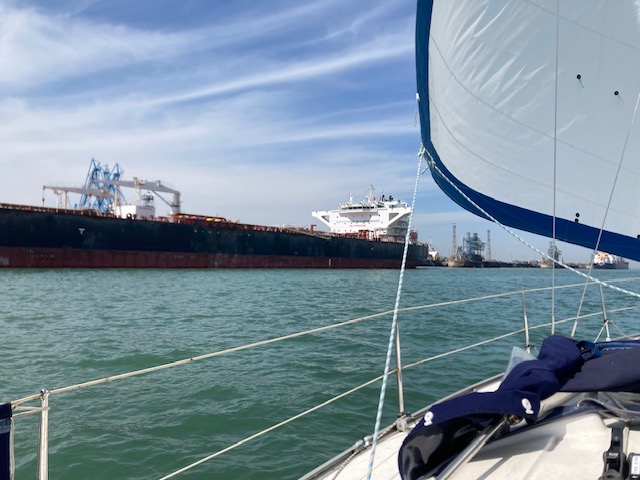
The busy Westbound shipping lane came and went, but the fog really descended as we approached the Eastbound lanes. We all independently had visions of huge bows of tankers suddenly appearing out of the 100-yard mist, but AIS came to the rescue (though we had the fog horns ready too). At one point, Captain Haddock’s Closest Point of Approach (CPA) was shown as around 1 mile, so we eventually hailed him on Channel 16. From what we could understand, he had seen us though we never saw him! Okolschitsa was our next AIS target, again due to pass us around 1 mile away. We never saw him either!
Bizarrely, almost the moment we cleared the shipping lane the fog abruptly disappeared and became a low grey line of cloud behind us as we carried on for the rest of the passage under clear blue skies and warm sun. We DID see Okolschitsa eventually as she appeared out of the mist away on our port quarter. She was not small!
 The run down to Les Hanois light and along S coast of Guernsey was delightful, along the dramatic rocky coastline so typical of many parts of the Channel Islands and N Brittany coast. The North going current bore us up to St Peter Port where marina staff met us and directed us to an excellent outside but walk-ashore pontoon (Inspire’s draft is too much to go over the sill and into Victoria Marina). Tired after a 12-hour passage so it was dinner and celebrations on board.
DAY 3 – Guernsey
Decided to stay only two nights before heading back north, to refuel, re-gather ourselves together and possibly see something of the island. There are regular bus services and our preferred option, the 91/92, does the perimeter circuit. However, passengers on a liner moored outside the harbour had the same idea, so rather than queue for what would be a packed small, single decker, we took the #41 alternative to Cobo Bay. A delightful spot, rocky coastline, some fine stretches of beach and an excellent coffee stop. Possibly the best decaff coffee I have enjoyed in ages.
Bus travel on Guernsey was also ‘interesting’. Narrow and twisting roads, many bounded by garden walls, forced the bus driver to use the pavement on a regular basis. It seemed to be the way of things!
Return to St Peter Port, refuel at the fuel pontoon, an afternoon rest and an evening meal at the Dix Neuf more than filled the rest of the day. (Had contemplated Cornerstone having enjoyed crab sandwiches there on a previous trip but given everyone’s preferences – and the fact that Cornerstone was up a steep hill – we decided they might be better as a lunch stop some other time!)
DAY 4 – Return across Channel to Salcombe
A 0700hrs start and a fast leg North up the Little Russel born by the tide (we saw 9 knots over the ground at one stage). We turned onto 309 degrees once past the Plattes Fougère, but with the wind now behind us and blowing roughly the same speed as we were making under motor (7 knots SE), that was the way things stayed.
We enjoyed clear visibly all the way across, and almost oppressive heat at times. T-shirt weather at the end of September??!
 Again, the shipping lanes were busy. We avoided the corner of the Traffic Separation Zone, and with hot sun, music and clear visibility, spotting and anticipating oncoming traffic held none of the ‘interesting’ times we experienced on the way over.
The passage was enlightened by visitations from several porpoises – or dolphins – and especially by the homemade French onion soup consumed for lunch on deck. The height of luxury!
The West bound shipping lane was equally busy, and we felt able to relax once we had passed the last of the potential obstacles.
We passed a highly suspicious metre-cube box floating nearby but decided not to investigate. Interestingly we thought a motor/ fishing boat way behind us might have been looking for it. Make of that what you will!
Again, AIS was our alert, fifth crew member, and a good job.
 Closing the Devon coast, we were taken aback by the appearance of more E & W bound commercial traffic passing between us and the shore. We thought we’d left them behind in the shipping lanes! More close encounters followed as they ploughed East born on in the strengthening East going current. We by this time we headed slowly in the opposite direction!
The current. As we neared the coast, we realised that the stronger than anticipated E going current was sweeping us sideways towards Start Point rather than towards Salcombe. We should have headed further to the West much earlier in our passage to allow for the ebb and flow. There’s a lesson here: Take closer account of expected tides (we were coming up to Springs) when working out the Course to Steer (CTS)!
 Finally, as we slowly butted the tide to make Salcombe we heard a Distress Call on CH16 for a small motorboat towing a Dory that had engine failure. We turned out to be the nearest boat. They were clearly visible, hugging the shore around Prawle Point, about a mile or so north of us. We were close but unable to help – we were towing our tender, and with a big draft and a falling tide, we needed to make it over Salcombe bar – but we liaised with the skipper and Falmouth coastguard and agreed to stand off until the inshore lifeboat reached them. A sun fish slowly passed our starboard quarter completely oblivious of the excitement above!
Beer and a bite on shore was welcome!!
DAY 5 – Salcombe to The Yealm.
 Another atmospheric, foggy start, but which had burned off by mid-morning to leave glorious views of the Salcombe estuary.
There was no need for an early start as The Yealm should be only a few hours back up the coast, so we took things easy and aimed for the next tidal window to cross the bar, in the early afternoon. An easy morning allowed time for showers ashore and a welcome lunchtime beer at the Salcombe Yacht Club.
By the time we cleared past Starehole Bay on the way out, the wind had risen to a fresh 11kn NW and we could actually sail for almost the first time. Two long, satisfying tacks saw us past Bolt Head and Bolt Tail and headed into Bigbury Bay.
Then circumstances intervened…
The winds close-into shore started to drop away under the shelter of the land, so we couldn’t make as much on the port tack as we had hoped. And the SE current had started so we were constantly being pushed back along the coast!
Then the winds freshened to 16kn NW which dictated one reef (and made handling much easier) but we still couldn’t point high enough to make good passage progress.
I’m afraid to say we had to admit defeat and start the donkey as we again needed to cross the shallow bar at the Yealm, and on a falling tide.
We made it, luckily found an excellent space on the first pontoon, tied up, jumped into the rubber duck and motored on up to the Yealm YC for a beer (Friday night, v noisy) before 30 yards wander to The Ship, which was rammed outside and in. Friday night revelry! We had booked a table which turned out to be in the middle of the noisiest thoroughfare beside the bar and had an amplified (but good) live singer 6 feet away … but the Mussels and Chips were excellent!
Thankfully, the tide had not gone out far enough to strand the rubber duck while we had been ashore, so with a shove and a paddle we were off back to the pontoon for a night-cap.
DAY 6 – Return to Plymouth
Very little wind from NW but a delightful, uneventful motor-sail past the Mew Stone, into Plymouth Sound by the E entrance and across the Bridge. The trip was short in distance but took a bit longer as the tide was starting to rush out over the Bridge and through the Narrows.
By the time we were tucked up again in the marina, the wind was all but gone (as predicted), the sun had regained its searing heat and the final breakfast in the cockpit was a treat before heading for the car and a remarkably swift, Saturday morning trip up the M5.
Yes, we didn’t get much pure sailing, but it was nonetheless a fine adventure with much enjoy and occupy our crew of 4, and good to have completed a long passage in style with the bonus of a visit to the Channel Islands. I am sure we will be back!
Morley. September 2026
 That afternoon we met up with Mark Aleandri who was 400 miles into his 630 miles Southwest Coastal Path walk, with 17 kilos on his back (having just finished a John O’Groats to Lands End solo bike ride a few weeks before)!
 We finished the evening off in the Bridge restaurant overlooking the harbour. I’m pleased to report that Mark completed the walk about two weeks later in Poole having set off from Minehead some 4 weeks before having gone through gales, heavy rain, fierce winds and some very hot days.
 We all met up for an impromptu drink on board Passim around 1700. One thing led to another and by the time we decided to eat it was too late to book a restaurant or order takeaways! Jim, being the perfect host, offered to knock something together and we had a lovely meal with plenty of wine and beer.
 Unfortunately, a problem surfaced on Free Spirit with the heads refusing to pump! Bob replaced the complete syphon unit but to no avail. This left the long outlet hose and the stopcock. Unfortunately, by the time this was established the chandlers had closed for the weekend. It was deemed too risky to sail with a potentially faulty stopcock so that was that until Monday!
 We had now run out of time on the slings, were lowered back into the water and we returned to our berth. Although the heads were working it was not a smooth operation. So back to the drawing board. Bob managed to pick up a length of hose first thing Tuesday morning and by an enormous amount of engineering know how plus brute strength he (with a little help from myself), managed to change out the hose. Success at last!
 We were en route to meet owner and skipper Jim on Passim a 49-foot sloop Jeaneau.
 Debra took the helm; she had not sailed for some years but proved she had not lost any of her skills.
 The evening was drawing on and by the time we decided to go for a meal ashore, all the local eateries had stopped serving. Ever resourceful, Jim produced a substantial meal for all of us on board together and a jolly good time ensued with stories of daring do, the Irish Sea, The Channel, Caribbean, and even the Bay of Biscay.
 The next day, quite late, Jim decided we could go out again but this time we just circled the Breakwater, with Bob at the helm to make up for all his and Robin’s travails.
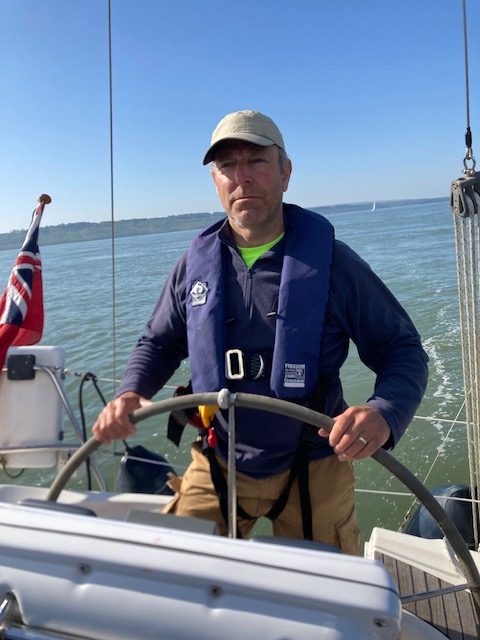 I would like to share my recent experiences under sail, using GSA yachts.
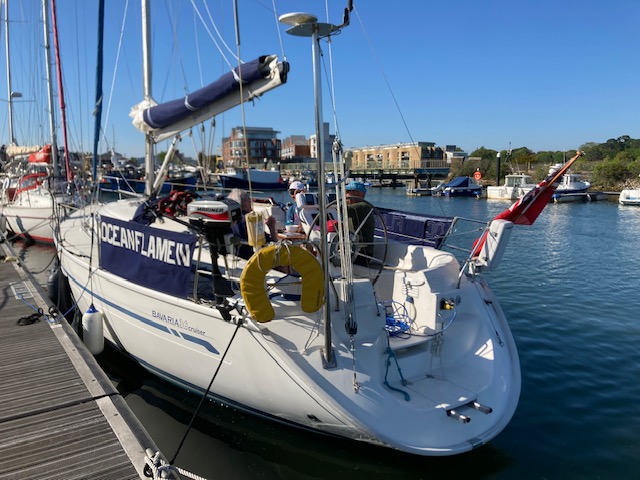 The cruise out of Southampton was again blessed with sunny skies, light winds and full Spring tides.
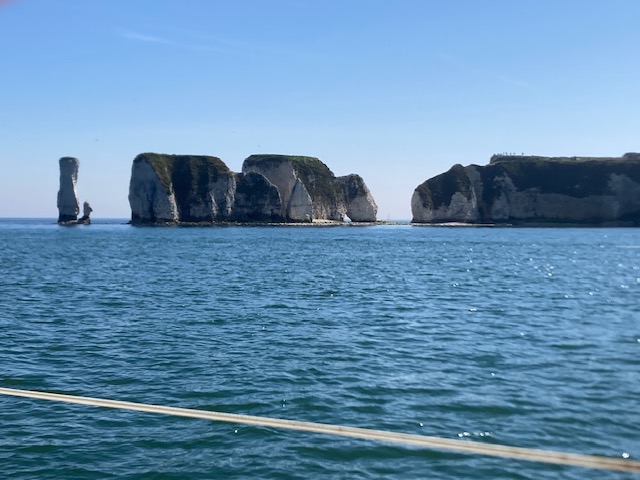 We also moored one day for a very scenic lunch, on the environmentally friendly buoys, just North of Old Harry Rocks. This allowed us just enough depth to enter Poole Harbour to moor for the night.
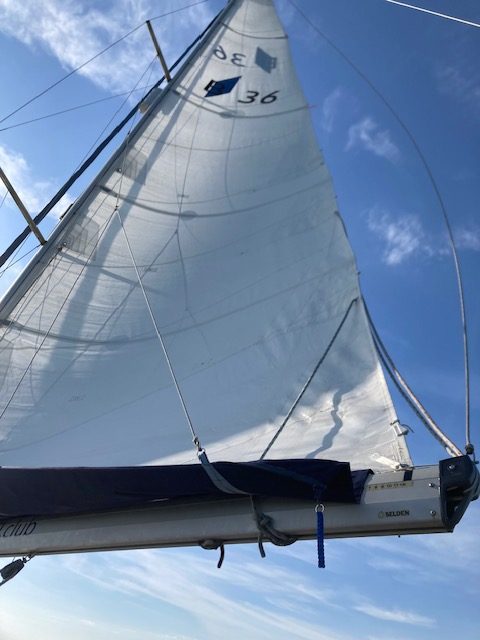 This is part of the GSA deal, where members are expected to act as part owners of the boats and service them accordingly. However this, in my opinion, is more than made up for by the fact that our chartering costs were approximately only two thirds of the cost of a similar commercial charter, for capable, well maintained and cleaned yachts. (It may be possible by your own arrangement to employ a harbour side boat cleaning for the task)
 The Plymouth plan was for MoT and Toroa to convene at anchor on Saturday evening (10 June) in Cawsands Bay ready for an early start on Sunday. Toroa, being single-handed, would accompany MoT for the Channel crossing. We would keep 2-hourly contact via channel 75 which worked until distance and until gremlins got into the electronics.
 The plan was to decide ‘go’/’no go’ – for Toroa at least – around midday, by which time we were some 5 miles south of Bolt Tail. As luck would have it, this was just the time the mist started to clear and the SW wind picked up. So ‘go’ it was, and we were fully under wind power alone after five hours on the donkey!
 Passim arrived from Lymington on Tuesday morning, after a long night passage and some motor sailing if I remember right. Cause for natural celebration later in the day after the crew had rested, with aperos on board Passim and an all-crews trip into town to Da Nello, an excellent Italian restaurant.
 The stay at Starehole was initially planned as a few hours break before heading out at midnight to join the newly west going current back to Plymouth. A double check showed up a significant error; the tide would not turn until early morning. Poor excuse and not surprising as it turned out that Plan A had been based on Dover rather than Plymouth/Devonport tides!
 Postscript. As far as we know, Passim set off back to Lymington 24 hours after the Plymouth contingent had departed (minus one crew member, I believe, ‘who had business back in town’*), stopping off in Alderney overnight before crossing.